RISING UP – a new EP release by Stephen Longfellow Fiske
Rising Up is a new EP release with video productions for each song from singer/songwriter/activist Stephen Longfellow Fiske. In Rising Up, Stephen has compiled 8 cuts, some old, some new, to speak out against and bring some inspiration for facing the totalitarian takeover of democracy being leveled against our citizenry by the tyranny of the current administration.
Stephen and filmmaker partner Robert Corsini have collaborated to produce the music-video, Rising Up. With additional footage recorded by colleague Jeff Kamen, Stephen added the in-studio created, Let Freedom Ring, based on the live and spontaneous Charlottesville No Kings rallies (2 & 3) that Jeff shot. Stephen, a long-time musician activist since the Civil Rights Movement, wrote a musical adaptation, Rising Up, based on the traditional freedom song, Ain’t Gonna Let Nobody Turn Me Around, thus connecting the legacy of the 60s with addressing the immediacy of these troubled times.
With lead singer BJ Lark, musician and engineer Jason Burke (who played bass, guitar, and sang), and vocalist Sondra Dunkin, Stephen recorded Rising Up where he lives in Virginia, and then brought the recording to be edited, mixed, and mastered in Los Angeles by musician/producer/engineer Mark Mattson, while enrolling Robert, his long-time partner in music-video and film production. The result is the music video, Rising Up, capturing the spirit of the nation-wide No Kings rallies. Stephen then went on to produce the whole EP with videos described below, partnering with video producers Tim Kummero on songs, The Machine and New Dawn, and with photo/journalist Justin Ginther on Bridges of Love. The songs in order: 1) The Machine; 2) Rising Up; 3) Let Freedom Ring; 4) We Carry the Dream; 5) They; 6) New Dawn: 7) Bridges of Love; 8) Earth Anthem.
Cut 1: The Machine
words and music by SL Fiske
Stephen wrote “The Machine” while he was the lead singer and writer with a San Francisco acid rock band, The Bycycle, in 1968, as a protest against the Military Industrial Complex during the Vietnam War. Although the Bycycle began recording an album in 1969 with engineer/producer/bassist Dan Healy, the album was never finished when tragedy struck and the band broke up. The Machine was one of the songs the band had not yet recorded, but it remained in Stephen’s repertoire as he pursued his career as a solo artist. A live but noisy in-club performance of the band performing the song was found by Dan, from which engineers Gopal Metro and Matt Mattson, through the magic of digital engineering, were able to extract and add some musical elements from the band’s live performance, such as guitarist Richard Treec’s lead guitar. Stephen updated and re-recorded the song for this project utilizing some musical elements from the Bycycle making this recording a hybrid of the 60’s band and now.
The Machine
Verse 1 – The wheel was invented, the stage was cemented
The builders all learned how the gears should be turned
And each passing scene found the monster machine
Growing too fast as the engineer’s grasp
Slipped out of control and was left somewhere in the past
The machine is driving the driver, the machine is driving the driver
Verse 2 – The media presents the choreography of events
As the puppets stagger each day through the play
Programmed to be hollow, geared only to follow
Led by the lines the machine defines
Fed by power and greed over human rights and needs while the planet bleeds
The machine is driving the driver, the machine is driving the driver
Verse 3 – Faster and faster the wheels of disaster
Keep spinning momentum insane on its course
Extracting and exploiting, war making and destroying
Captured by the grip of the suicidal script
Asleep at the wheel of the machine,
you better wake before the crash in the final scene
The Machine is driving thew driver, the machine is driving the driver
SL Fiske, guitar and vocals, Mark Mattson, bass and digital programming, The Bycycle (Richard Treece, guitar, Dan Healy, bass, Al Rose, B3 organ, Butch Giannini, drums, SL Fiske, lead singer), engineered by Gopal Metro and Mark Mattson, mixed and mastered by Mark Mattson
Cut 2: Rising Up
adapted from the traditional freedom song, Ain’t Gonna Let Nobody Turn Me Around with new words and music by SL Fiske.
Stephen invited singer BJ Lark to the sessions at Jason Burke’s studio in Central Virginia where the initial tracks of Rising Up were recorded. Stephen had met BJ during the successful protest which stopped the Atlantic Coast Pipeline, and she and Stephen had built a strong musical and activist connection which was re-experienced during the sessions. This kicked off the whole project, as Stephen then brought the recording to Mark Mattson and to filmmaker Robert Corsini in LA. The footage shot by Jeff Kamen in Let Freedom Ring is of the Charlottesville No Kings Rallies edited to the soundtrack by Robert and Stephen.
Rising Up
Ain’t gonna let no dictator turn me around, turn me around, turn me around
Ain’t gonna let no dictator turn me around, we got democracy, not autocracy
We’re rising up in resistance now
Ain’t gonna let no ICE Raids turn me around, turn me around, turn me around
Ain’t gonna let no ICE Raids turn me around
Gonna keep persisting, keep resisting, rising up in resistance now
Ain’t gonna let no police state turn me around, turn me around, turn me around
Ain’t gonna let no police state turn me around, we got democracy, not autocracy
We’re rising up in resistance nolw
We fought a revolution, no king, no king
We wrote a constitution, no king, no king
We got democracy, not autocracy. We’re riding up in resistance now
We got we the people, no king, no king
Indivisible, no king, no king
We got democracy not autocracy, we’re rising up in resistance now
Rising up, rising up
For dignity, decency, honesty, give me some integrity, please
Speaking truth to power, getting into good trouble
We got democracy not autocracy, we’re rising up in resistance now
We’re rising up in resistance now!
SL Fiske, vocals, guitar, djimbe and percussion, Jason Burke, guitar, bass, vocals, BJ Lark, lead vocals, Sondra Dunkin, vocals, Mark Mattson, keyboards
Cut 3: Let Freedom Ring
created by SL Fiske, Mark Mattson, with John D’earth and friends
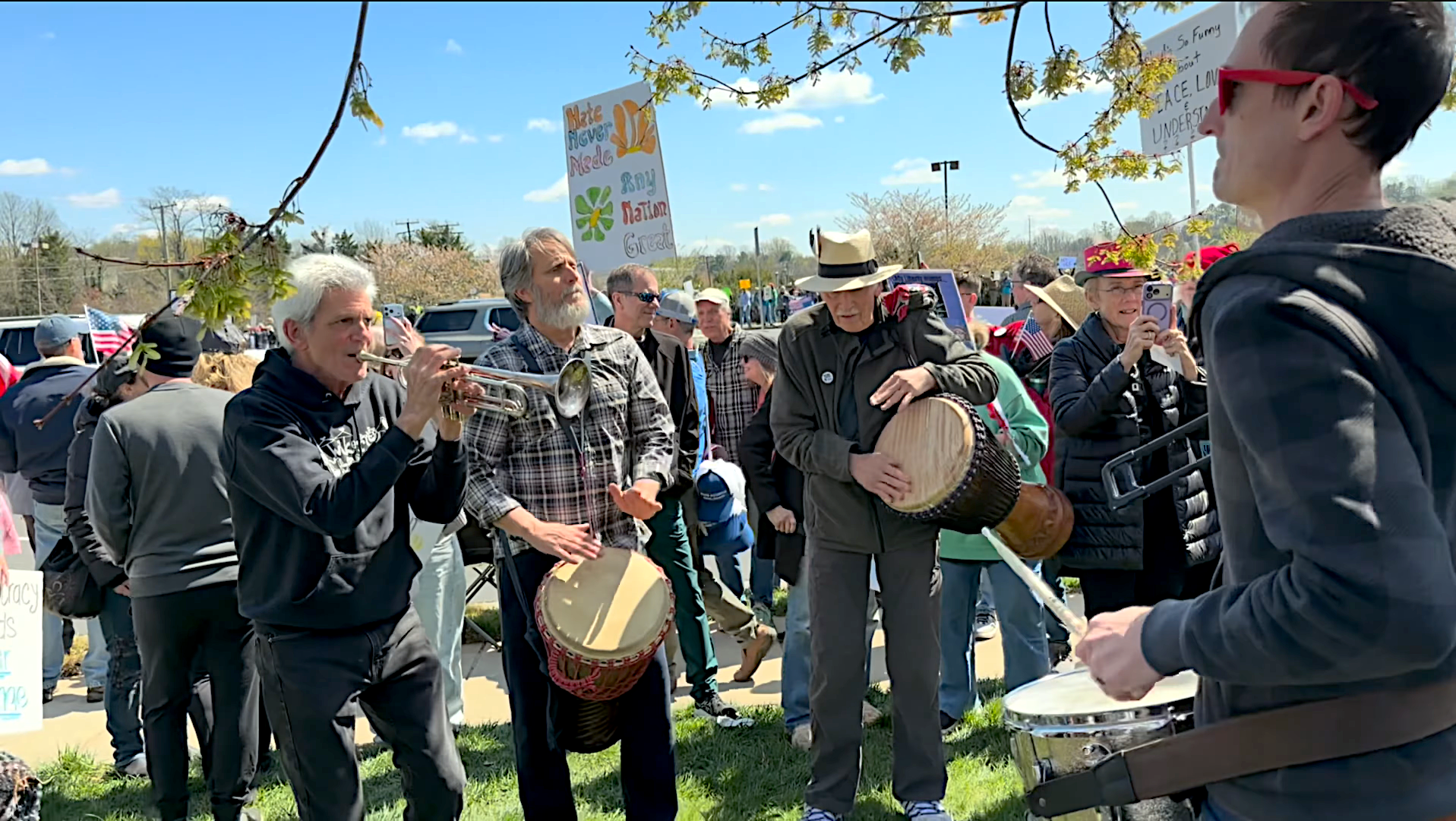
At the April 18, 2026 No Kings Rally in Charlottesville, Virginia, attended by 10,000 people, Stephen came with his djimbe over his shoulder and wound up immersed in a drum circle and musical jam session. In addition to the several drummers and the throng of others clapping, dancing, singing, and banging on tambourines and frame drums, they became a spontaneous band of trumpets, trombone, tuba, and violin, fully engaged in free-form jamming, surrounded by the crowd of rally participants. The playing lasted non-stop for two hours. This was a spontaneous combustion of improvised rhythms and music which brought dancing and celebrating in the midst of the dedicated rally and protest. The spontaneous horn section was led by well-known trumpeter, John D’earth, whom Stephen had never met before, whose riffs and runs were obviously that of an accomplished musician. Jeff Kamen came by to film part of this musical happening, and later sent the recording to Stephen who brought it to LA. From Jeff’s videos of No Kings 2 & 3, Stephen and Matt were able to extract portions of a chant Stephen led from No Kings 2 and edit it together with the jam from No King 3, and then chant a rhythmic rap to the track which created Let Freedom Ring.
Chant – O Say can you see, we are here for democracy (3x)
We are here to let freedom ring, Democracy has no king (2x)
Let freedom ring, let freedom ring, democracy has no king (2x)
We are here to let freedom ring. Democracy has no king (2x)
Freedom, let freedom ring, freedom, let freedom ring
Cut 4: We Carry the Dream
words and music by SL Fiske and Sophia
In August, 1963, when Stephen was 17 and just learning the guitar and writing songs, he travelled from home in New York City to Washington DC for the Great March on Washington where Martin Lyther King Jr. gave the “I Have a Dream Speech.” Stephen had participated in Civil Rights marches in NYC but this historic march became a turning point in his life, as he witnessed and experienced firsthand that participation from we the people is what makes all the difference in our social/political quest for reforms. Years later, in collaboration with fellow singer/songwriter, Sophia, they penned We Carry the Dream, which is making its debut release in Rising Up, along with the music-video created with Robert Corsini.
We Carry the Dream
Verse 1- One fine summer day, 1963
The great march for Civil Rights took on Washington DC
They marched for freedom, they marched for jobs, they marched for dignity
They marched for the conscience of a nation, for justice and equality
Verse 2 – A quarter million gathered there in Washington that day
to hear the reverend Dr. King lift his voice and say
“I have a dream” and we witnessed history
Now it’s up to all of us to carry the legacy
Chorus – Now we’re singing, we carry the dream of the way this world could be
We carry the dream of justice and equality
When we gather together we find strength in unity
Yeah, we carry the dream, all people shall be free
Verse 3 – From the streets of Birmingham to that Nobel Prize he won
Reverend King let freedom ring, shined his light for everyone
Now people anywhere who’ve been denied their rights
Find freedom strength and inspiration to carry on the fight, so we’re singing..
(repeat chorus)
Bridge – You can’t keep a baby from needing to be touched and loved
You can’t keep the trees from reaching for the sky above
And you can’t keep the river from rolling to the sea
And you can’t keep the people from the hunger to be free, so we’re singing…
Repeat chorus (2X) and ride out – we carry the dream, we carry the dream…
SL Fiske, guitar and vocals, Jeff Breeh, bass, Hal Ratlff, piano, Drew Hester, drums, Barry Fasmen, orchestrations, Jeffrey Clayton, saxophone and string arrangements, Eloah Shaddai, Tina Meeks and friends, bg vocals – engineering by Barry Fasman
Cut 5: They
words and music by SL Fiske
They is a satirical lyric, reminiscent of Tom Leher, of the way we so easily put blame or praise on others (they) and stand by while wrongs and injustices, or good and beneficial things are being done by those around us, while we often are guilty of standing by and doing nothing. It’s easy to blame or praise some generic “they” rather than look in our own mirror and take responsibility ourselves. In the end, “they” are really extensions of ourselves, as fellow members of the human family, challenged and striving to exert influence, control, and power, or to coexist, cooperate, collaborate, and share responsibility for doing the work of overseeing and bettering our troubled world.
They
Verse 1 – In my short life I’ve met my share of people
I’m always meeting new folks every day
But a certain kind of person has escaped me
It’s the human species commonly known as they
Verse 2 – They’re the ones who’ve been making all the progress
We’ve even seen some of them walking up on the moon
But down here on Earth they’ve got us in a big mess
And I hope they get us out of it real soon
Chorus – Cause they do this and they do that
They’ve been doing it throughout all history
And if you need someone to blame or to praise, it’s all the same
They will take responsibility
Verse 3 – They’re the ones who are building bombs and planning wars
We can believe the\m when they say our fear should cease
They say there is no need for paranoia
They’re only building bombs to keep the peace
Verse 4 – They’re the ones who’ve been messing up the environment
They’re the ones who say they’ll clean it up
Now they’ve got us in the existential threat of climate change
And they’ve given eternal life to the Styrofoam cup
Repeat chorus
Verse 5 – They’re the ones who’ve been playing partisan politics
They just can’t agree and they cannot collaborate
They point their fingers ‘cross the aisle and claim the other side’s to blame
And they’ll use fake news to bring us up to date
Verse 6 – They’re the ones advancing AI technology
It’s going faster than their ability to control
Now they’ve taken it on to recreate and recalibrate God’s role
To birth sentient robots’ body, mind, heart, and soul
Repeat chorus
Verse 7 – Now just who is this they of whom I’m singing?
Does someone have a clue who they might be?
Well it’s possible I think they could be the missing link
But I hear they look a lot like you and me…
Cut 6: New Dawn
words and music by SL fiske
This song was written after Stephen and a friend climbed to the top of Mt. Whitney in California’s Sierra Nevada mountains. It’s a really steep and challenging hike up the tallest mountain in the contiguous 48 states carrying heavy packs. They spent the night atop the peak at 14,505 feet, at a rare time of year when the full moon was rising and the Sun was setting. They stood on the apex between the energies of these two most influential orbs of our earthly existence. The next morning, they watched the new sun rise over a new day and a new hope for our world, and a song was born…
New Dawn
verse 1 – I climbed a mountaintop and stool up on the crest
Full moon rose in the East, gold sun set in the West
The rock spoke through my feet, my heart beat in my breast
I laid my tired body down but I could find no rest
Beneath the stars I heard the wild night-winds blow
Voices of ages called to me from long ago
Ascending constellations crossed the mystic skies
A thousand questions seemed to wait for my reply
And so, the night passed on the peak waiting for the dawn to call
And so I heard a voice within me speak “before the new can come the old must fall.”
Chorus – Hold on through the night, make way for the light
Coming ‘round burning bright – new dawn
Verse 2 – The dawn broke crystal clear with an amber glow
Illuminating peaks and valleys far below
And as I rose and made my way down through the snow
I knew that dawn would stay with me wherever I would go
And as I travel down life’s long and twisting road
And face whatever trials the future shall unfold
I know it’s just an old way yielding for the new
I know it’s just a new dawn waiting to shine through
And so there sings a song in me waiting for so long to be sung
A song of the dawn, and of the Earth and sun
And of the light that shines in everyone
Repeat chorus…
SL Fiske, guitar, vocals, Jeff Breeh, bass, Oliver Brown, conga, bongo, percussion,
Mark Mattson, keyboards
Cut 7 – Bridges of Love
Words and music by SL Fiske and Jai Josefs
Bridges of Love is a song Stephen recorded when he was signed to the Higher Octave Music label, working with producer Skip Wise in 1994. Stephen has always felt the song has great relevance and upliftment for today’s times.
Bridges of Love
Verse 1 – If we can build great bridges
across the mighty waves between distant ridges
Is it a task too great to build a bridge ‘cross the depths of hate
For now more than ever, what the world needs more of
Is to reach for each other with bridges of love
Verse 2 – If we can reach so far
to send men up to the moon and rockets to the stars
Why are we still so far apart, why can’t we find the way
from soul to soul, from heart to heart?
For now, more than ever, what the world needs more of
Is to reach for each other with bridges of love
Bridge – Bridges of steel reach from shore to shore
But bridges of love reach so much more
They link our common hopes, our common ground
Joining one and all the whole world round
Verse 3 – We all can build bridges of love each day
With our eyes, our smiles, our touch
With our will to find a way
There is no distance we cannot span
The vision is in our hearts, the power is in our hands
For now, more than ever, what the world needs more of
Is to reach for each other with bridges of love (2x)
Sl Fiske, vocal, Jeff Order, piano, John Mahan, drums, Tom Tucchiarone, bass, Tim Timmermans, percussion, Mark Lavang, keyboards, string arrangements, Neal Morse, electric guitar, Esther Terry, Neal Morse, SL Fiske, bg vocals – Produced by Skipper Wise for Higher Octave Music
Cut 8 – Earth Anthem
A new verse sung to the melody of the Star Spangled Banner
Written and sung by SL Fiske, string arrangement by Ed Cohen
The Evolution of a Song – a Brief History
The song that we in the United States sing as our national anthem, The Star Spangled Banner, was written as a poem by Francis Scott Key on the deck of a small boat on September 14, 1814, during the War of 1812. Key was observing the bombardment of Fort McHenry at Baltimore Harbor by the powerful British fleet from a neutral launch. Key, an attorney with a poetic bent, had been sent by President Madison to negotiate the release of an American physician, Dr. William Beanes, held prisoner aboard the British fleet.
After having already burned the Capital Building and the White House (which was under construction), the British approached Baltimore Harbor, intent on sacking the city of Baltimore. The Americans, however, were well prepared and turned back an invading British land force. The Americans had sunk barges at the mouth of the inner harbor, preventing the British fleet from achieving point blank range for their bombardment. Francis Scott Key was inspired by the heroic American stand, which saved the city of Baltimore and set back the powerful British gunships. Inspired at the sight of the American flag still flying over Fort McHenry after a day and a half of heavy rocket exchange, Key jotted down some lines on an envelope and wrote out the verses when he later returned to shore. The verses were written scanned to a popular melody sung in the American colonies. It was published the very next day on a broadside (handbill) entitled In Defense of Ft. McHenry, was tacked on tavern doors, and quickly met with wide public approval.
The melody to which the stanzas were written was that of an English drinking song, To Anacreon in Heaven. Anacreon was the convivial Greek poet whose verses celebrated love and wine, and who became the patron saint of the Anacreontic Society, a gentlemen’s club, whose enthusiastic and bawdy meetings had gained quite a reputation, and from whence the song became popular. To Anacreon in Heaven was sung in taverns throughout Colonial America, and by 1814 was an American standard. To that tune, in 1798, Thomas Paine had written a patriotic verse, Adams and Liberty, which became well known around the young nation.
When Francis Scott key’s verses were tacked onto the doors of Baltimore’s taverns, his song was heartfully sung as a celebration of victory in battle and of national pride. As the popularity of Key’s song grew, the original Anacreontic song, Paine’s version, and other attempts to write verses to the old drinking song (including one by Dr. Oliver Wendell Holmes), were forgotten. Key’s most popular verses, The Star Spangled Banner, became the favorite national song. In 1931, Congress officially designated it as the United States National Anthem.
Now, in the ongoing folk tradition of adding new verses to old songs, visionary singer/songwriter Stephen Longfellow Fiske brings the evolution of a song extolling war and flag and “bombs bursting in air” to be transformed into a song of peace and global harmony, blending democratic ideals with the imperative of planetary environmental sustainability.
Earth Anthem
O say can you see, by the one light in all
Our Earth to embrace at the call of all nations
Where our children can play in a world without war
Where we stand hand in hand in the grace of creation
Where the rivers run clean through the forests of green
Where the cities stand tall in the clear skies of freedom
O say do our hearts sing out for harmony and love forever
On the planet of our birth blessed with peace on Earth